
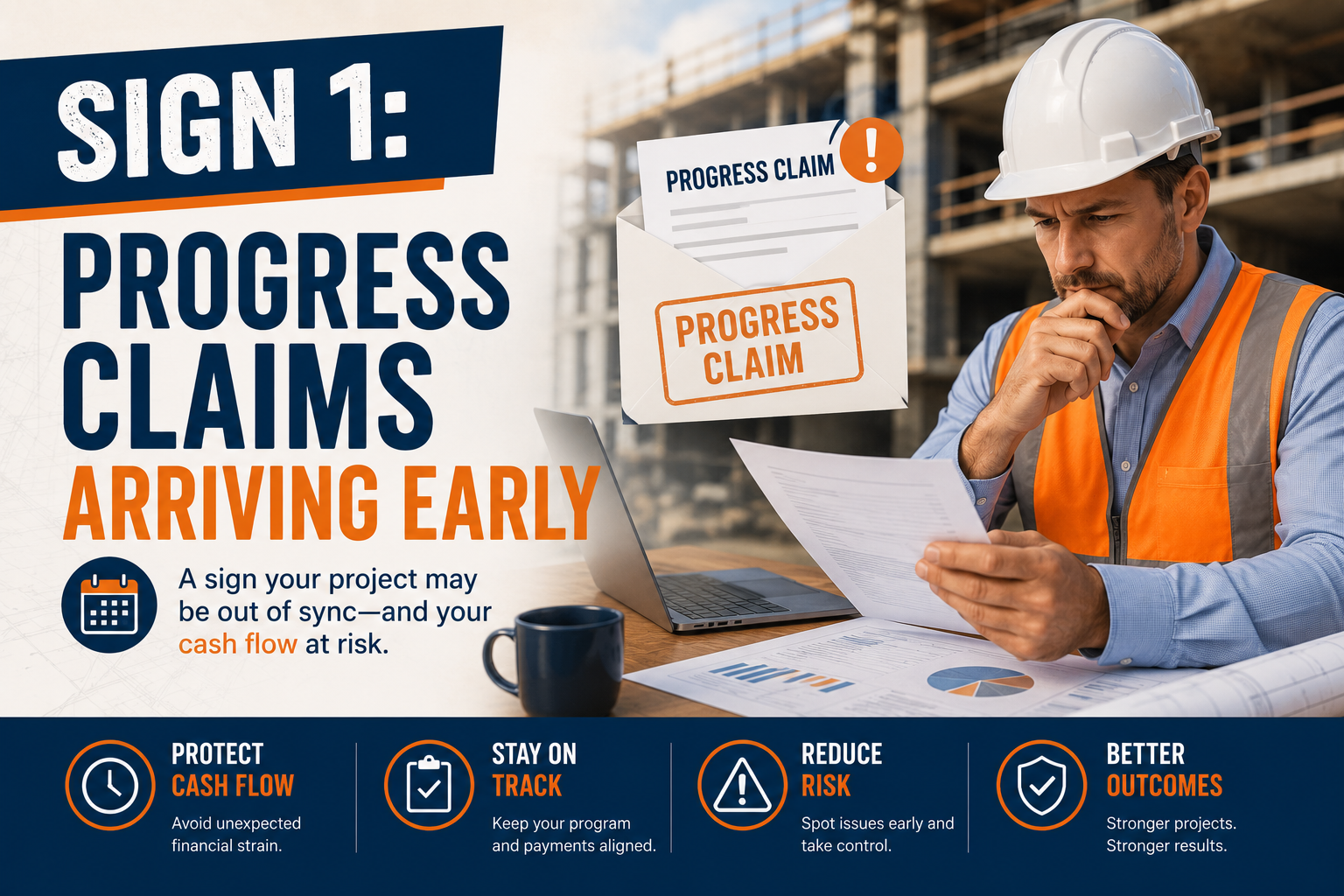
A builder who submits progress claims early, or claims amounts above the contractual milestones, is often managing cashflow difficulties or over-claiming. Review every progress claim against the actual work completed before authorising payment. Overpayments are almost impossible to recover if the builder encounters financial difficulty.
Sign 2: Increasing Number of Variations
A small number of variations is normal. A large and growing number of variations — particularly for items that should have been in the original contract — suggests the builder tendered at an unrealistically low price and is recovering margin through the variation process. Review each variation carefully against the contract documentation.
Sign 3: Trades Disappearing From Site
If your site is regularly empty, or trades stop appearing without explanation, the builder may be diverting labour to other projects or experiencing subcontractor payment disputes. A healthy project has continuous activity on site through the construction phase.
Sign 4: Programme Slipping
If programme milestones are consistently being missed — even by small amounts — the cumulative effect will be significant. A builder who is 2 weeks behind on each of the first 5 milestones is likely to finish 4–6 months late. Address programme slippage early and formally, in writing.
Sign 5: Requests for Information (RFIs) Ignored or Delayed
Builders use RFIs to seek clarification on the design. A high volume of RFIs is a sign of documentation quality issues. RFIs that go unanswered by the design team are a sign of poor project management. Either way, unanswered RFIs slow construction and give the builder legitimate grounds for delay and variation claims.
Signs 6–10
Sign 6: Subcontractors telling you about payment issues — contractors talk to owners when the head contractor isn’t paying them. Sign 7: Quality of work declining mid-project — often a sign of financial pressure and corner-cutting. Sign 8: Builder becoming less communicative — hard to reach, slow to respond, avoiding site meetings. Sign 9: Unexplained material substitutions — different products to those specified being installed without formal variation approval. Sign 10: Work failing inspections — building surveyor raising non-compliance issues that the builder is slow to rectify.
What to Do If You See These Signs
First, document everything — all communications in writing, all progress claims reviewed and annotated. Second, obtain professional advice from an architect or construction lawyer before the situation escalates further. Third, consider engaging Integral Design Solutions as a project manager or project advocate if you are not already using one. We have substantial experience in taking over struggling projects and bringing them back on track.
Ready to Get Started?
Contact Integral Design Solutions today for expert construction project management and dispute resolution services in Melbourne and Victoria. Visit integraldesignsolutions.com.au/ or call us to book a free consultation.