
If you’ve ever looked at a set of architectural plans and felt overwhelmed by the flat lines and technical symbols, you’re not alone. Traditional 2D drawings are the language of the construction industry — but they’re not always the easiest language to understand if you’re not an architect or builder.
That’s where 3D visualisation comes in. But which do you actually need — and when?
Here’s everything you need to know about 2D and 3D architectural drawings, and how Integral Design Solutions uses both to deliver exceptional project outcomes.
What Are 2D Architectural Drawings?
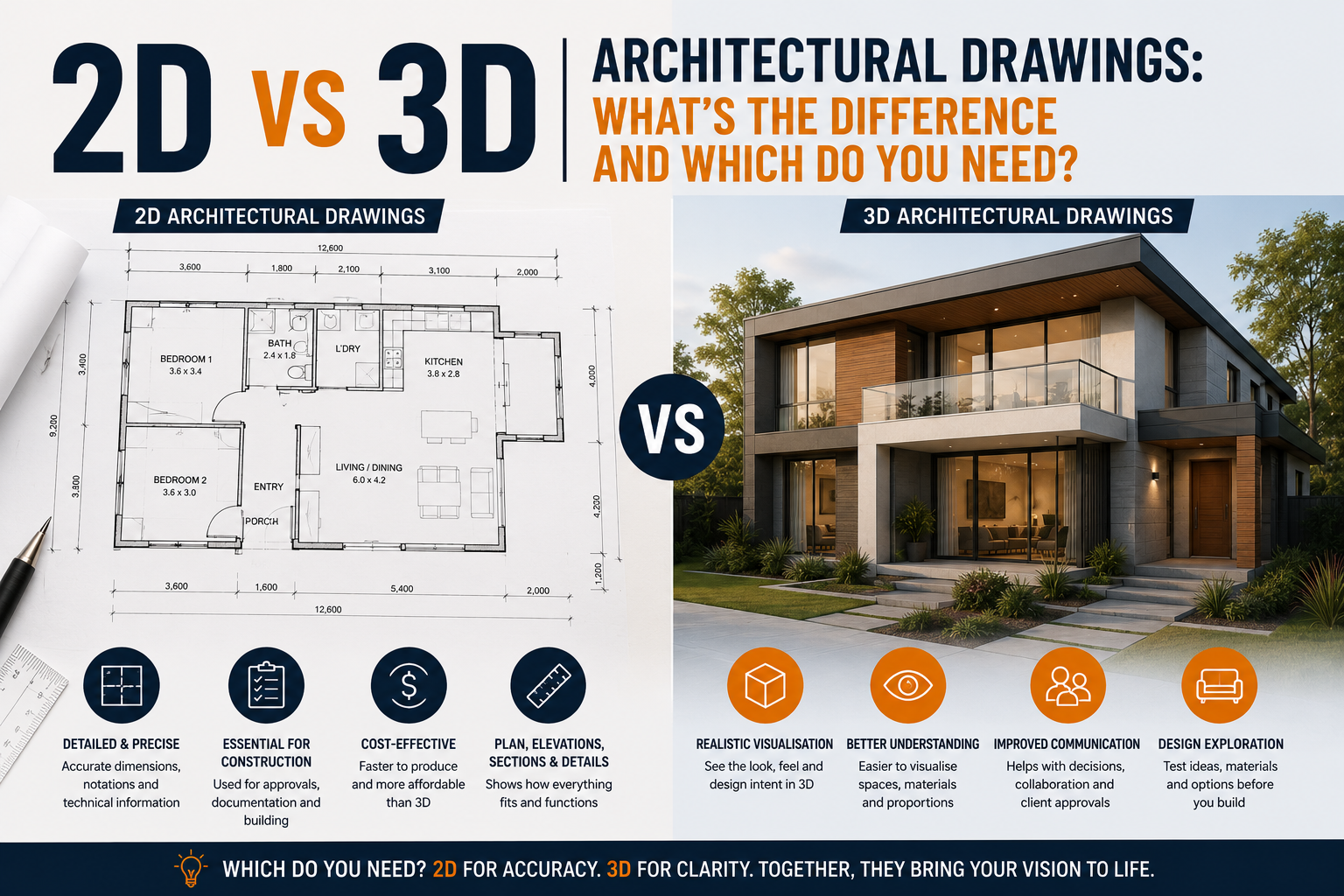
2D drawings are flat, orthographic representations of a building. They include:
- Floor plans (viewed from above)
- Elevations (views of each façade)
- Sections (slices through the building)
- Detailed construction drawings
These are the technical documents that builders, engineers, and councils use to assess, approve, and construct a building.
2D drawings include:
- Dimensions
- Material specifications
- Structural details
- Compliance information
They are the legal documents of the construction process — every building permit application in Victoria requires a complete set of 2D construction drawings.
What Are 3D Architectural Drawings and Renders?
3D drawings and renders provide a photorealistic or semi-realistic view of what your building will look like before construction begins.
They can show:
- Exterior views from any angle
- Interior perspectives
- Material finishes
- Natural light and shadows
- Landscaping context
Modern 3D architectural visualisation can be so realistic that it’s difficult to distinguish from photography.
This technology allows clients to:
- Experience their future building
- Identify design issues early
- Make informed material and finish selections
- Improve confidence before construction begins
Key Differences at a Glance
| Feature | 2D Drawings | 3D Renders |
|---|---|---|
| Purpose | Construction & compliance | Design communication |
| Required for permits | Yes | No (but helpful) |
| Readable by clients | Moderate | Very easy |
| Shows materials | Via notation | Photorealistically |
| Used by builders | Yes — primary docs | Reference only |
| Cost | Included in design fee | May be additional |
When Do You Need 2D Drawings?
Always.
For any building work that requires a planning permit or building permit in Victoria, you will need a complete set of 2D construction drawings.
These are non-negotiable and typically include:
- Site plans
- Floor plans
- Elevations
- Sections
- Construction details
Without them, your project cannot proceed through approvals or construction.
When Do You Need 3D Renders?
3D renders are not legally required, but they are enormously valuable for projects where design quality matters — which is most projects.
They are particularly useful when:
- Visualising material choices before committing
- Presenting designs to councils for permit applications
- Marketing off-the-plan residential or commercial developments
- Explaining complex designs to clients or stakeholders
- Making design decisions that are difficult to communicate in 2D
How Integral Design Solutions Uses Both
At Integral Design Solutions, we provide comprehensive 2D construction drawings for all projects — these are the working documents your builder needs.
We also offer detailed 3D visualisations that allow you to see your project in photorealistic quality before construction begins.
Our 3D service has helped many clients identify design improvements that saved significant money, time, and disappointment down the track.
Frequently Asked Questions
Can I use 3D renders for my planning permit application?
Yes. 3D renders can be included in planning permit applications to help councils visualise the proposed development in context.
They are particularly useful for:
- Infill developments
- Heritage-sensitive areas
- Large residential projects
- Commercial developments
How much do 3D architectural renders cost in Melbourne?
Basic 3D renders typically start from around $500–$2,000 per view.
Highly detailed photorealistic renders with landscaping and advanced finishes can range from $3,000–$10,000 per view.
Many architectural firms, including IDS, include basic 3D visualisation within their design fee.
How long does it take to produce architectural drawings?
A complete set of construction drawings for a residential project typically takes 4–8 weeks.
More complex commercial or multi-residential developments may take 3–6 months, depending on project scale and approval requirements.
Ready to Get Started?
Contact Integral Design Solutions today for expert architectural drawing and 3D visualisation services across Melbourne and Victoria.
Whether you need permit-ready construction drawings, photorealistic 3D renders, or complete project support, our team can help bring your vision to life.